The Daily Parker

Politics, Weather, Photography, and the Dog

Update to Weather Now

Weather Now release 5.0.9330 came out this afternoon. The only difference is the way it stores weather lists.

When you go to the site, it shows you the weather in a short list of places from around the world. If you register by logging in with a Microsoft account, you can personalize this list. Previously the app stored this personalized weather list as part of the user's profile and stored the system default list (shown to unregistered users) as a simple configuration setting.

This release moves weather lists to their own data structure, so that (a) administrators can edit the system default list on the fly and, eventually, (b) users can have multiple lists. This also means the app now has a designated weather list editing page.

Next up on the feature roadmap:

  • Create and edit multiple weather lists per user
  • Choose which weather lists to show on the main page
  • Show normal and record temperatures for some US stations
  • Show historical climate data for some US stations

That said, I have another major project that will take precedence over these updates, so I don't expect another Weather Now release until late fall or even early winter. And if you want to see a new feature on the app, let me know in the comments.

I'd open the windows, but it's soupy

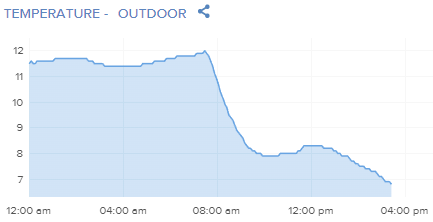
Just look at that cold front, wouldn't you? And notice how the dewpoint dropped hardly at all:

The same thing happened at the official Chicago station at O'Hare, where the temperature dropped from 31°C to 22°C in 15 minutes, while the dewpoint went up. At least the forecast predicts tomorrow will be lovely.

In a related note, the OAFPOTUS's and the Republicans' 40% reduction in funding to the National Oceanic and Atmospheric Administration stopped the agency's Atlas 15 project, which will have a ripple effect through urban planning and disaster management for decades:

The tool is part of the National Oceanic and Atmospheric Administration’s Atlas 15 project — a massive dataset that will show how often storms of a given duration and intensity could be expected to occur at locations across the United States. The project was intended to be published in two volumes: one that would assess communities’ current risks and a second that would project how those risks will change under future climate scenarios.

The release of Atlas 15 had been long awaited by civil engineers, regional planners and other groups that use NOAA’s precipitation frequency estimates to develop regulations and design infrastructure. Many parts of the country rely on decades-old data to determine their rainfall risks, and there is no authoritative national dataset of how rainfall and flood threats will rise in a warmer world.

But work on Atlas 15’s climate projections has been on hold for months after Commerce Secretary Howard Lutnick ordered a review of Volume 2 this spring, according to current and former NOAA officials with knowledge of the project.

The review of Atlas 15 is among a number of efforts by the Trump administration to curb climate science. The administration dismissed the scientists responsible for writing the National Climate Assessment — a congressionally mandated study typically published every four to five years — and dismantled the program that oversees the reports. In a budget document submitted to Congress last month, Trump proposed zeroing out funding for NOAA’s climate research and eliminating many of the agency’s laboratories and institutes.

Do you know that more Republican voters live in areas negatively affected by climate change than Democratic voters? Neither did they.

We cannot comprehend the damage this administration has already done to the United States. And they plan to do so much more.

A moment of downtime

I've gotten some progress on the feature update, and the build pipeline is running now, so I will take a moment to read all of these things:

  • Radley Balko looks at the creation of what looks a lot like the OAFPOTUS's Waffen-Shutzstaffel and says we've lost the debate on police militarization: "In six months, the Trump administration made that debate irrelevant. It has taken two-and-a-half centuries of tradition, caution, and fear of standing armies and simply discarded it."
  • Linda Greenhouse condemns the pervasive cruelty of Immigration and Customs Enforcement under Tom Homan: "Something beyond the raw politics of immigration lies behind the venomous cruelty on display, and I think it is this: To everyone involved, from the policymakers in Washington to the masked agents on the street, undocumented individuals are “the other” — people who not only lack legal rights as a formal matter but who stand outside the web of connection that defines human society."
  • Paul Krugman explains more cogently than I did why the Republicans cutting NOAA will hurt everyone: "Trump’s cuts to scientific research aren’t about shrinking government and saving money. They’re about dealing with possibly inconvenient evidence by covering the nation’s ears and shouting 'La, la, la, we can’t hear you.' "
  • The inconvenient evidence includes a growing realization in Mediterranean countries that their summer resorts are no longer habitable in the summer: "Across Spain, Italy, Greece, France and beyond, sand-devouring storms, rising seas, asphyxiating temperatures, deadly floods and horrific wildfires have year after year turned some of the continent’s most desired getaways into miserable locales to get away from."
  • Ilya Shapiro, constitutional studies director at the Manhattan Institute, believes both the left and the right have got Amy Coney Barrett all wrong: "She’s an originalist with a strong devotion both to constitutional text and institutional procedure. But she’s also a stickler for prudence in the face of novelty. The one thing Barrett is zealous about is upholding the rule of law..."
  • A group of mayors from the Chicago suburbs has decided they don't like the very same public-private partnerships between railroads and their surrounding areas that created many of the same suburbs: "Real estate could be the recipe for long-term fiscal sustainability for [the Northern Illinois Transit Authority, making some of the current revenue mechanisms only temporary and reducing the risk of a repeat of this year's fiscal cliff. [But y]ou can’t protest government overreach of private property rights, and then defend zoning in the same paragraph."
  • At the same time suburban mayors rant against better transit, their residents have clogged half the side streets in Chicago to get around Kennedy Expressway construction this summer. Of course, better transit would obviate all those car trips that cause the congestion in the first place, but let's not think too hard about that.
  • In some parts of the country, though, street designs from the Netherlands have become more popular as planners and citizens see how much safer they are for everyone.
  • Patrick Smith takes a look at last month's Air India crash and fears the worst: "[I]f the [fuel] switches were moved to CUTOFF manually, the billion-dollar question is why? Were they moved by accident, or nefariously? Was it an act of absurd absent-mindedness, or one of willful mass murder, a la EgyptAir, Germanwings, and (almost certainly) MH370."
  • Google announced a new partnership with electric truck maker Rivian to use Google Maps for navigation.
  • New studies suggest that we have crooked teeth because our diet changed: "With softer diets came less mechanical strain on the jaw. Over generations, our mandibles began to shrink— a trend visible in the fossil record."

Finally, a number of commentators have experienced a healthy dose of Schadenfreude watching the OAFPOTUS's rabid followers turn on him, including Adam Kinzinger, Josh Marshall, Dan Rather, and of course, Jeff Maurer. It's not exactly "the blood of Marat strangles him," but as a centrist, I am enjoying this part just a little. (And in fairness, Kinzinger, a Republican, believes that the administration's policies will do more damage to the party than this nonsense about Epstein.)

A grift we knew was coming: selling the weather

As everyone should know by now, everything the OAFPOTUS or anyone around him does is in the service of self-enrichment. We can include "enriching friends" as well. And in the grand tradition of privatizing things that government absolutely does better than industry, it looks like the Administration intends to cripple the National Oceanic and Atmospheric Administration (NOAA) so their friends can start making rents from the vital functions it performs.

Enter Neil Jacobs, nominated to head NOAA, who claimed without evidence in a confirmation hearing Wednesday to undo the damage the Clown Prince of X inflicted on the agency:

“If confirmed, I will ensure that staffing the Weather Service offices is a top priority,” said Jacobs, who led NOAA on an acting basis in Trump’s first term. “It’s really important for the people to be there because they have relationships with people in the local community. They’re a trusted source.”

The agency’s staffing levels have been in the spotlight due to the recent floods. While NOAA sent a wide range of warnings and alerts prior to the storms that caused the deadly floods in Texas, Senate Minority Leader Chuck Schumer, D-N.Y., called on the Commerce Department’s inspector general to launch an investigation into the impacts the staffing cuts had on the crisis in Texas. That request is currently under review by the IG’s oversight teams, a spokesperson said.

Asked whether he supports President Trump’s proposal to cut NOAA’s budget by 27% in fiscal 2026, Jacobs confirmed that he did and suggested funding was being refocused from research to operations. The “mission-essential functions” of the National Weather Service and the National Ocean Service would continue, he said.

I'll believe it when I see it, Jake. At least Jacobs has a PhD in atmospheric science.

Another atmospheric scientist, meteorologist Alan Gerard, has a cogent and probably-correct hypothesis about why the OAFPOTUS made those draconian cuts to NOAA:

I have had many conversations with colleagues in recent weeks about the proposed NOAA budget cuts, and in the course of those discussions I have heard (and offered) many explanations, from the one that I gave to the reporter, to revenge against NOAA for Sharpiegate, to privatization of weather forecasting, etc. As I thought more deeply about all of this, though, I realized that I - and perhaps my colleagues, though I won’t speak for them - was likely looking at this from too myopic of a point of view.

I think the reality is that rather than support for weather science being caught in the flotsam of an anti-climate effort, weather and climate science are caught in the flotsam of anti-science efforts.

The administration’s own NOAA budget document states the need for an NWS that can provide “operational forecasts, warnings, impact-based decision support services (IDSS) and other life-saving products and services to the emergency management community and public as they prepare for and respond to increasingly frequent severe weather and water events (emphasis added).” The administration itself acknowledges the increasing frequency of events and hence growing societal needs for warning and forecast services. Destroying the NOAA research-to-operations structure built over decades seems all too likely to yield an NWS unable to evolve to meet those growing needs.

And yet I think the anti-science part isn't the point. As PBS reported earlier this week, administration officials from Commerce Secretary Howard Lutnik on down have financial interests that would benefit from outsourcing these functions to private firms. So instead of our tax dollars supporting weather research and forecasting, our tax dollars would support those things plus profits for private interests.

Again, it's all about the grift.

In a similar vein, I'm working on a hypothesis that tanking the economy through tariffs could just be about enriching bond holders, because if interest rates go up, we would pay more to the wealthiest among us in mortgages, student loans, credit-card interest, and yes, Federal bond coupons. Because to the OAFPOTUS and his friends, it's totally fine to burn everything down as long as they can profit from the ashes.

That has been the Republican Party since before Reagan was president. They've just stopped concealing it under this administration, because they're so close to everything they've ever wanted, they don't care who who knows.

Well, *this* disaster wasn't their fault, but...

It took several hours after the Gila River started rising for a general alert to go out. This doesn't appear to be anyone's fault so much as the way the alert system works, which is why a bill recently proposed in the Texas legislature would provide much-needed money to upgrade the system. Unfortunately for Texans who live near rivers, Republicans in the state house killed the bill in the most recent legislative session.

New York State has a similar problem. The Dept of Homeland Security just cancelled a $3 million grant to enhance "last-mile" alerts in extreme weather events, even as recovery workers found more bodies in Texas:

As the Empower website puts it, “By integrating advanced analytics, real-time localized high resolution Mesonet-based weather data, critical infrastructure ‘lifelines,’ social vulnerability data, and novel visualization capabilities, the Empower tool will provide a rapid assessment of changing weather conditions and their potential impacts on communities and critical infrastructure.”

But on Tuesday the grant recipients at State University of New York, Albany were notified by DHS in a termination form dated July 8th that the entire grant was being “terminate[d] for the convenience of the Government.” The order, signed by DHS contracting officer John Whipple, instructed researchers to immediately cease work on the project.

So while the Texas disaster last week wasn't the fault of Texas Republicans or the OAFPOTUS's hand-picked clown college, future disasters will certainly have higher tolls because of their actions.

My GOP friends: the Republican Party told you for decades it wanted to "drown the Federal government in a bathtub," and you either didn't believe them or thought that was just fine. At the moment, I don't care which. You will have some explaining to do later on, though.

It's cooler but still sticky

The temperature dropped 7.7°C in the last 90 minutes, and yet it still feels sticky. I had hoped to take Cassie to the beach one last time before her surgery Tuesday; unfortunately, the lines of thunderstorms accompanying the cold front did not allow it.

So, at least she'll get another decent walk today (she's already had over an hour, including a 5 km walk before breakfast), and tomorrow it looks like it'll be cooler and drier.

Also, I fixed a long-standing architectural problem with the way Weather Now handles weather lists for registered users (not yet in production though) that will enable users to add multiple weather lists in the future. As with all architecture fixes, however, it took a lot of running in place: 6½ hours and it works the same as before. (I hope to push these changes into production next week.)

Using the day productively

I started today a bit earlier than I usually do because I woke up somewhere between dawn and my usual time of 6:30. So, with the extra morning time, the day still cool enough to enjoy, and the rain still about an hour away, I took Cassie on a 3½ km walk before 7am. Then I sat down and refactored how Weather Now stores personal weather lists. Sometimes you just have to run with your creative energy, you know?

Cassie needs another walk, and I've (mostly) finished the feature, so I'm now going to enjoy the rest of my holiday, and contemplate whether America will make it to 250 years old with most of its Constitution intact.

Halfway through the year already

Somehow, tomorrow is July 1st. As far as I can tell, this is because today is June 30th, and yesterday was June 7th, and last week was sometime in 2018.

And yet, I have more stuff to read at lunchtime from just the last day or so:

And now, despite an uncomfortable 34°C heat index, I must walk Cassie.

Still hot, but just a bit cooler

Inner Drive Technology World HQ hit 34.3°C yesterday afternoon and only cooled down to 25.7°C by 6 this morning. As we do on hot days, Cassie and I started our long walk just before 7am, doing exactly 5 km in 50 minutes while the temperature (and dewpoint) rose a full degree.

Fortunately, it looks like a much-anticipated cool front went through just after 10. I wouldn't know; I've been in meetings. So I'm about to take Cassie out again before the thunderstorms hit.

I might even have time later today to read all the horrible things going on in the world. My tl;dr: no one actually knows what will happen next in the Middle East, least of all the OAFPOTUS, which you can tell because any bad thing he says about someone else, he's really projecting about himself.

Back in the office

I got in a bit early this morning to beat the heat. Good thing, too, as my train line partially shut down upstream of my stop just as I got on the train. It's up to 34°C at O'Hare and 33°C at Inner Drive Technology World HQ (feels like 42°C—107°F), with a forecast of 36°C and continued horrible heat indicies for this afternoon when I walk Cassie home from dog school.

Chicago isn't the only place getting this awful weather. The record heat will affect over 200 million people this week with similar temperatures from North Carolina to Connecticut hitting tomorrow.

Meanwhile, the Lake Michigan-Huron system's water level has dropped more than 150 cm since its soggy peak in 2020, giving us our beaches back and ending routine flooding on lakefront streets on the South Side. (Don't worry, we still have a fifth of the world's fresh water.)

The weather should moderate tomorrow, with thunderstorms coming through in the afternoon. I very much preferred the weather in Seattle this past weekend, though. And I hope that Cassie and I can get some real walks this week.